This article and associated images are based on a poster originally authored by Sophie O’Neil, Kyle Thompson, Rita Pereira, Emily Russell and Stuart McElroy and presented at ELRIG Drug Discovery 2025 in affiliation with BioAscent Discovery Ltd and University of Glasgow.
This poster is being hosted on this website in its raw form, without modifications. It has not undergone peer review but has been reviewed to meet AZoNetwork's editorial quality standards. The information contained is for informational purposes only and should not be considered validated by independent peer assessment.

Introduction
- 5-HT2A receptors are expressed abundantly in the CNS and are attractive clinical targets for anxiety, psychosis and OCD.
- 5-HT2B receptors are expressed in the cardiovascular system, and their chronic activation is known to induce adverse cardiopulmonary effects.
- Many 5-HT2A ligands lack specificity, leading to off-target 5-HT2B effects.
- Differences in GPCR expression levels and the presence of receptor reserves can alter both the receptor coupling efficiency and the apparent pharmacological profile of ligands 1,2.
- We use the 5-HT2A/2B receptors as a case study to demonstrate how these factors may result in underestimation of compound activity and misrepresentation of clinical safety and efficacy, highlighting the need for careful mechanistic evaluation.
Methods
Multiple HEK-293T cell lines stably expressing human 5-HT2A or 5-HT2B receptors were generated at BioAscent via cationic lipid-mediated transfection and Hygromycin B selection. Receptor expression levels were quantified in all clones by RT-qPCR, and three clones per receptor were progressed, based on a range of expression levels (Figure 1), for full pharmacological characterisation using intracellular Ca2+ mobilisation FLIPR (Figure 2) and xCELLigence label-free impedance (Figure 3) assays.
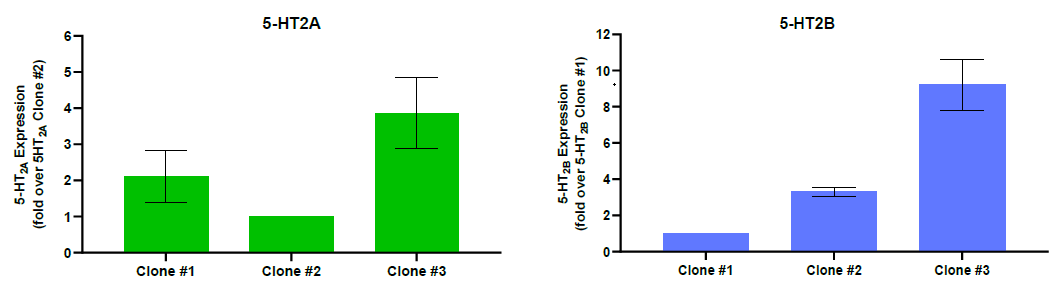
Figure 1. Quantification of 5-HT2A/5-HT2B receptor expression by RT-qPCR. 10 ng of cDNA was used for qPCR with PowerUpTM SYBR Green Master Mix. Transcript levels were normalised to GAPDH and expressed relative to the lowest expressing clone using the 2-ΔΔCt method. Mean triplicate expression data ± SEM is shown. (n=3/N=3). Image Credit: Image courtesy of Sophie O’Neil et al., in partnership with ELRIG (UK) Ltd.
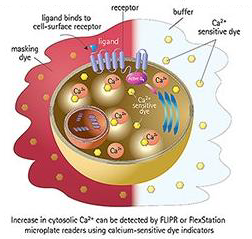
Figure 2. Schematic overview of the Ca2+ mobilization assay. Image Credit: Adapted from product insert R8190, Molecular Devices, 2019.
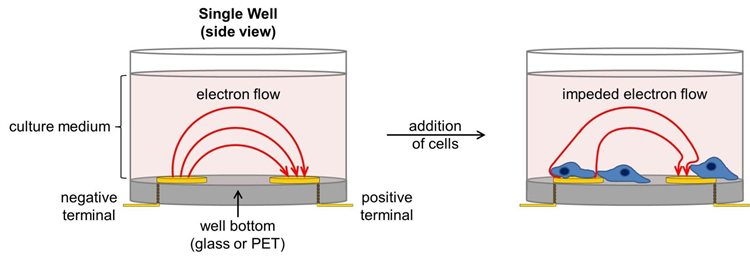
Figure 3. Principle of the cellular impedance xCELLigence assay. Image Credit: Adapted from Agilent, www.agilent.com/en/technology/cellular-impedance
FLIPR – Intracellular Ca2+ release assay
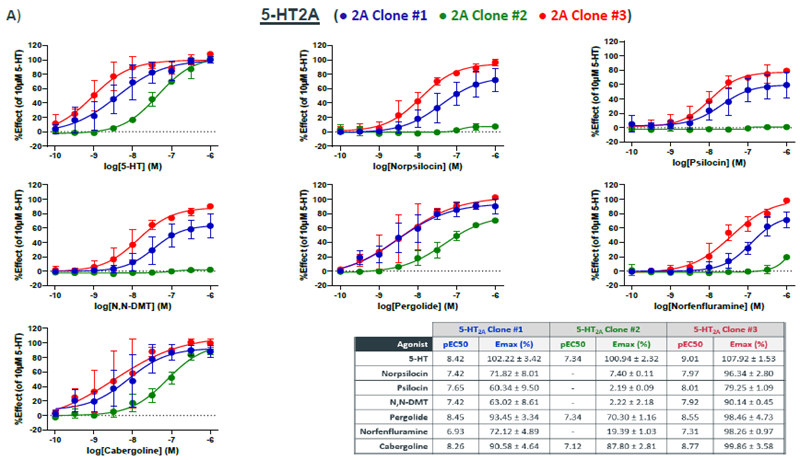
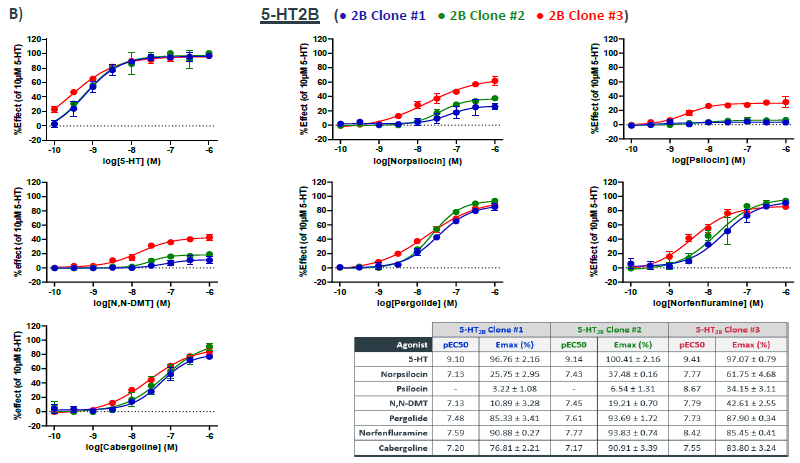
Figure 4. 5-HT2 receptor agonists show expression-dependent potency and efficacy profiles at 5-HT2A and 5-HT2B receptors. Agonist DRCs were normalised to DMSO (min control) and 10 μM 5-HT (max control) and plotted for 5-HT2A (A) and 5-HT2B (B) stable cell clones. Mean duplicate data from three independent runs (n=2/N=3) is shown ± SEM. Mean agonist potencies (pEC50) and mean Emax ± SEM are tabulated for each clone. Image Credit: Image courtesy of Sophie O’Neil et al., in partnership with ELRIG (UK) Ltd.
xCELLigence – 5-HT2A cellular impedance assay
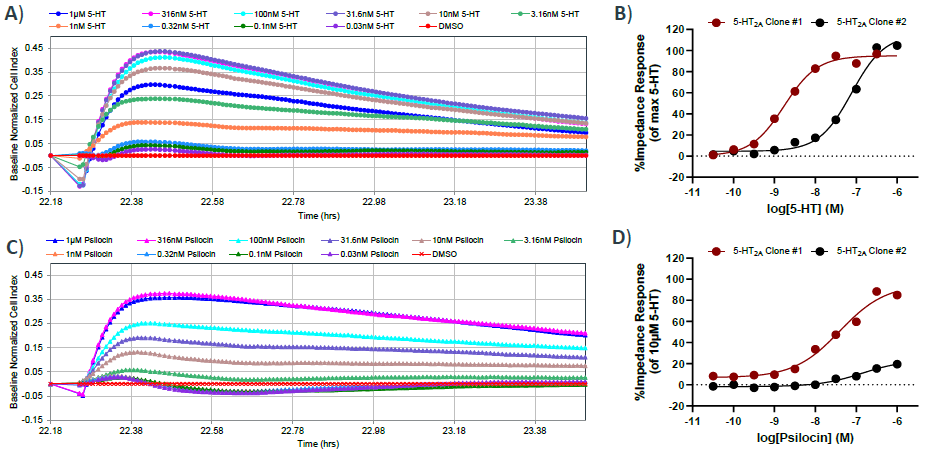
Figure 5. 5-HT2 agonists produce positive dose-dependent impedance responses. Normalised cell index traces (A, C) from 5-HT2A Clone #1 following stimulation with 5-HT (A) and Psilocin (C). Normalised cell index values were converted to ‘% Impedance Response’ relative to the baseline and 10 μM 5-HT responses, and plotted as dose-response curves for 5-HT2A Clones #1 and #2 (B; 5-HT, D; Psilocin). Image Credit: Image courtesy of Sophie O’Neil et al., in partnership with ELRIG (UK) Ltd.
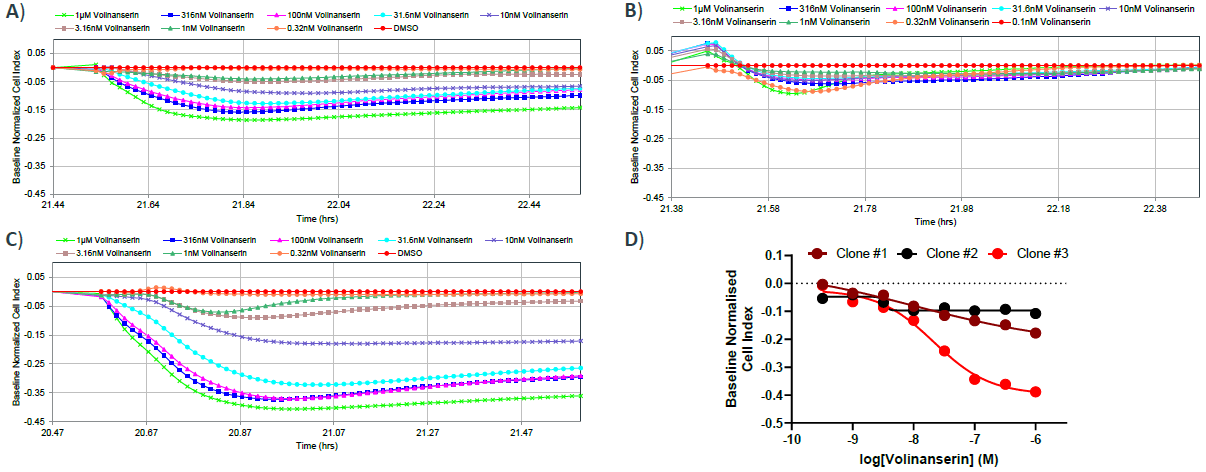
Figure 6. The 5-HT2A inverse agonist, Volinanserin, produces a negative dose-dependent impedance response in 5-HT2A clones with high receptor reserves. Normalised cell index traces from 5-HT2A Clone #1 (A), Clone #2 (B) and Clone #3 (C) following pretreatment with Volinanserin. Baseline normalised cell index values for all three clones were plotted against Volinanserin concentration, to generate inverse agonist dose-response curves (D) at the peak negative impedance response. Image Credit: Image courtesy of Sophie O’Neil et al., in partnership with ELRIG (UK) Ltd.
Conclusions
We show that differences in receptor levels significantly alters the pharmacological profiles of 5-HT2A/2B ligands across different assay technologies. Failure to account for receptor density/reserves may lead to underestimation of partial agonism/inverse agonism and off-target toxicity in pre-clinical screens, especially for CNS-active compounds like psilocin/norpsilocin. These findings underscore the necessity to incorporate multiple physiologically-relevant models and assay approaches into pre-clinical drug safety/efficacy profiling, to ensure accurate predictions of clinical outcomes.
References
- Jacobson, K.A. (2015). New paradigms in GPCR drug discovery. Biochemical Pharmacology, 98(4), pp.541–555. DOI: 10.1016/j.bcp.2015.08.085. https://www.sciencedirect.com/science/article/pii/S0006295215005146?via%3Dihub.
- Li, A., et al. (2023). Loss of biased signaling at a G protein-coupled receptor in overexpressed systems. PLOS ONE, 18(3), e0283477. DOI: 10.1371/journal.pone.0283477. https://journals.plos.org/plosone/article?id=10.1371/journal.pone.0283477.
About BioAscent Discovery
Founded in 2013, BioAscent is a leading provider of integrated drug discovery services based at the former Organon / MSD R&D site in Newhouse, Scotland, UK.
About ELRIG (UK) Ltd.
The European Laboratory Research & Innovation Group (ELRIG) is a leading European not-for-profit organization that exists to provide outstanding scientific content to the life science community. The foundation of the organization is based on the use and application of automation, robotics and instrumentation in life science laboratories, but over time, we have evolved to respond to the needs of biopharma by developing scientific programmes that focus on cutting-edge research areas that have the potential to revolutionize drug discovery.
Comprised of a global community of over 12,000 life science professionals, participating in our events, whether it be at one of our scientific conferences or one of our networking meetings, will enable any of our community to exchange information, within disciplines and across academic and biopharmaceutical organizations, on an open access basis, as all our events are free to attend!
Our values
Our values are to always ensure the highest quality of content, that content will be made readily accessible to all, and that we will always be an inclusive organization, serving a diverse scientific network. In addition, ELRIG will always be a volunteer-led organization, run by and for the life sciences community, on a not-for-profit basis.
Our purpose
ELRIG is a company whose purpose is to bring the life science and drug discovery communities together to learn, share, connect, innovate and collaborate, on an open access basis. We achieve this through the provision of world-class conferences, networking events, webinars, and digital content.
Sponsored Content Policy: News-Medical.net publishes articles and related content that may be derived from sources where we have existing commercial relationships, provided such content adds value to the core editorial ethos of News-Medical.Net which is to educate and inform site visitors interested in medical research, science, medical devices and treatments.
Last Updated: Jan 6, 2026