TIDES are gaining recognition as promising therapeutic candidates, valuable due to their precision and versatility in targeting a wide range of diseases, from cancer and diabetes to osteoporosis and cardiovascular diseases.
TIDES therapeutic benefits include target specificity, drug efficacy, patient safety, druggable indications, and low costs, prompting an increase in marketed products over the past ten years.
NMR for structure characterization: FDA and EMA recommendations
NMR is widely regarded as the "gold standard" for chemical structure characterization across a range of modalities, including TIDES. NMR’s ability to provide detailed characterization is key to its support in discovery, development, and manufacturing.
Recent draft guidance documents by both the FDA and EMA indicate a requirement for enhanced TIDES characterization. NMR is recommended as a suitable high-resolution, state-of-the-art analytical technique for the characterization of sequence, composition, higher-order structure, stereoisomeric character, and identity.
High-field NMR solutions from Bruker are enabling scientists to adhere to the stringent requirements set by regulatory bodies, making compliance easier for pharmaceutical companies.
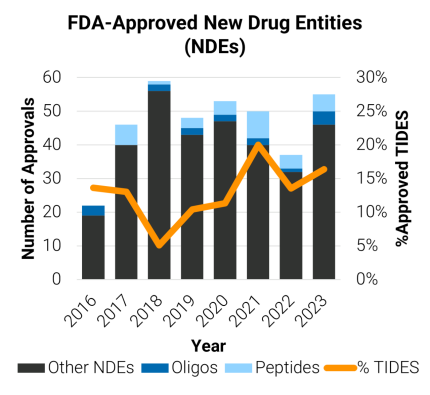
Image Credit: Bruker BioSpin Group
Bruker solutions: Instrumentation and probes
Bruker continually improves its NMR technology to deliver reliable, cutting-edge analytical solutions that adapt to pharmaceutical companies’ changing needs. The company’s 500 and 600 MHz Ascend Evo instruments provide the resolution necessary for more confident peptide assignments and oligonucleotide stereoisomer characterization.
The fit-for-purpose three millimeter Multi-Nuclear Inverse (MNI) CryoProbe™ can deliver results more quickly than room-temperature probes, helping to bring potentially life-changing TIDES therapies to market faster.
Benefits
NMR offers a wide range of benefits in TIDES characterization.
Adherence to regulatory standards
NMR can generate high-quality data on the critical quality attributes needed to support the depth of characterization required by the FDA and EMA, including amino acid sequence, oligonucleotide stereochemistry, peptide structure, PS:PO ratios, and residue modifications.
Accelerated analyses
Unparalleled accuracy, enhanced resolution, and speed in TIDES characterization are possible using the 500–600 MHz NMR instrument combined with the improved sensitivity from a dedicated MNI CryoProbe™.
Multiple targeted workflows
NMR is a multi-attribute method, meaning it can be used for TIDES identification, content quantification, structure verification, screening, purity, rational design, and quality control.
Precise and efficient quantification
Streamlined qNMR workflows can be used to directly measure absolute content, determine PS:PO ratios, and monitor critical quality attributes without needing reference material calibrations.
Enhanced selectivity
Direct detection of 31P and 19F nuclei enables more precise analysis of complex molecules by offering clear insight into backbone linkages, fluorinated labels, and modifications.
A scalable platform
Thanks to easy technology transfers, the same core NMR capabilities and validated workflows can be used from method development to QC and manufacturing.
Improved eco-friendliness and cost-effectiveness
Using the 3 mm MNI CryoProbe™ for qNMR workflows requires less sample than standard-sized probes, no reference material, and a fraction of the solvent versus chromatographic techniques.
Acknowledgments
Produced from materials originally authored by Bruker BioSpin GmbH & Co. KG.
About Bruker BioSpin Group
The Bruker BioSpin Group designs, manufactures, and distributes advanced scientific instruments based on magnetic resonance and preclinical imaging technologies. These include our industry-leading NMR and EPR spectrometers, as well as imaging systems utilizing MRI, PET, SPECT, CT, Optical and MPI modalities. The Group also offers integrated software solutions and automation tools to support digital transformation across research and quality control environments.
Bruker BioSpin’s customers in academic, government, industrial, and pharmaceutical sectors rely on these technologies to gain detailed insights into molecular structure, dynamics, and interactions. Our solutions play a key role in structural biology, drug discovery, disease research, metabolomics, and advanced materials analysis. Recent investments in lab automation, optical imaging, and contract research services further strengthen our ability to support evolving customer needs and enable scientific innovation.
Sponsored Content Policy: News-Medical.net publishes articles and related content that may be derived from sources where we have existing commercial relationships, provided such content adds value to the core editorial ethos of News-Medical.Net which is to educate and inform site visitors interested in medical research, science, medical devices and treatments.